 Whale Wise
Connecting with Giants; Behind the Scenes with Data Processing.
As seen in this month’s newsletter.
Whale Photo-ID: A Rewarding Game of Patterns and Memories
By Johanna Behrisch
Have you ever wondered how researchers identify individual whales in the vastness of the ocean? It might sound impossible, but humpback whales have a unique feature that helps us: the black-and-white pattern on the underside of their flukes (tails). Much like human fingerprints, no two flukes are the same. This method, called photo-identification, allows us to track the lives and movements of these giant creatures.
Since 2018, our team has compiled a master catalog of 551 individual whales encountered during our field seasons. Every year, we add to this catalog by identifying whales observed during that season. Last year alone, we took images of 175 whales using drones, and every one of them needed to be matched against the master catalog to check if it was a familiar fluke or a new friend. Matching isn’t always straightforward. While the fluke’s underside is the most distinctive feature, it’s not always visible, especially when using drones for aerial photos. In those cases, we rely on other clues, like scars on the top of the fluke, the back of the whale, the black and white pattern on the pectoral fins or even the tiny hairy bumps (tubercles) on the whale’s head. Sometimes it’s easy to recognize a whale, but other times it can take hours to match just a couple of them.
So, why do I enjoy spending hours pouring over whale photos? For me, it’s more than a task, it’s a game. Matching patterns and remembering identities feels like playing an advanced memory game. Over time, you start to recognize certain whales by their scars or marks, and it’s thrilling to say, “Wait, I’ve seen this one before!” Sometimes my brain surprises me with how quickly it recalls tiny details from hundreds of whales. It’s addictive, like solving a puzzle, and its great mental exercise, especially after a day of staring at spreadsheets or juggling numbers. And yes, this hobby has crept into my personal life. I now find myself looking closely at whale flukes in nature documentaries or online photos, secretly hoping one of “our” whales will pop up. It hasn’t happened yet, but I’m holding out hope!
Incorporating photo-ID into my daily life has become a rewarding routine. I fit it in when I need a break from desk work, often pairing it with music, podcasts, or audiobooks. I often make myself a nice cup of coffee and prepare some snacks before diving into the photos. I’ve found that dedicating 2 to 3 hours every other day works best for me. After that, my brain starts to tire, and it gets harder to stay focused on matching patterns. But within that time frame, it’s an incredibly rewarding experience that balances work and relaxation. On weekends, it feels more like a hobby than work. Even when the images are tricky, it’s more like a fun brain workout that keeps me engaged without feeling too exhausting or intense. Long train rides are also perfect for this task, letting me pass the time while doing something meaningful.
Photo-ID work offers a unique connection to the lives of these gentle giants, allowing us to track their journeys and gain a deeper understanding of their world. It’s a challenging, rewarding, and surprisingly addictive process. Most importantly, it’s a valuable tool for studying humpback whales and contributing to their protection.
Now it’s your turn to give it a try! Below are images showing the underside and topside of four whale flukes. Examine their patterns closely and see if you can determine whether they belong to the same whale or different ones. (Hint: Pay attention to unique scars, markings, or shapes in the black-and-white patterns!)

Winter work from the Southern Hemisphere
By Jessica Ward
I tell a lie. For me, it is actually summer. I am currently far away from the Icelandic humpbacks, living in Australia for a new life chapter. Luckily for me, there is a lot of data processing and analysis to be done, from our three field seasons in the westfjords of Iceland on those cold and snowy days that seem somewhat impossible to remember now I face the endless Aussie sun. So I am never far from Whale Wise and from the whales after all; just how I like it.
I am currently working through our 2024 data, simultaneously with Rebekka and Alyssa. As you can imagine, we have hours worth of footage filmed over four months and of over 100 whales. We want to extract raw data that we can use for scar analysis. So, this is where the man power comes in! We watch through each video, to extract aerial images: one whale per day per location. We split the humpback body into three segments, so for one day a whale might have one, two or three corresponding ‘screenshots’. This depends on many factors, for example the clarity of the image and the water, the position of the whale, the quality of filming etc… Segment one is the fluke, two is the middle and three is the head (see photos below for an example).

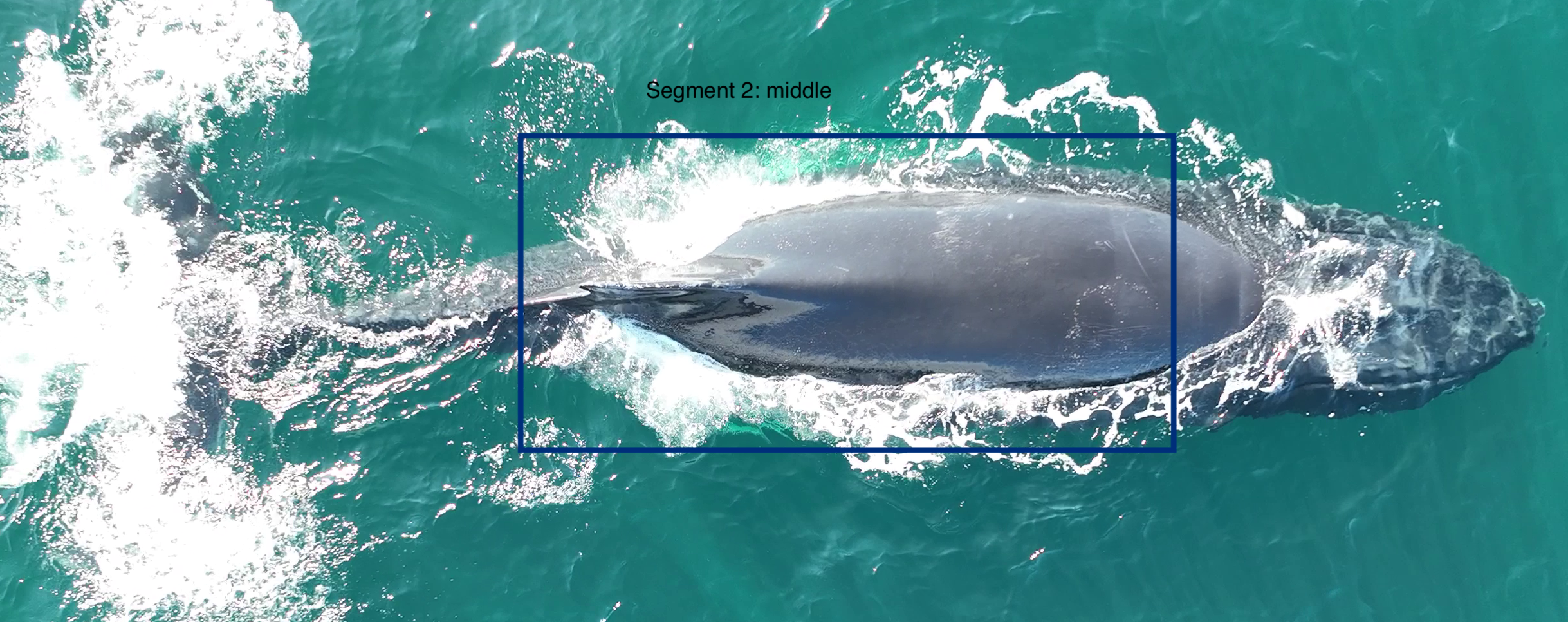
Last year I spent many rainy London nights doing this exact same process with the 2023 data. Now complete, this data is ready to be analysed: do the whales have scars? If so, do they have entanglement scars? We are then one step closer to matching these whale segments with body condition data and hopefully answering our research questions, predominantly: are whales that are more scarred from fishing equipment thinner and therefore less healthy?
This data processing can seem to be never-ending and also difficult to juggle amongst setting up a new life across the pond, starting new work and hobbies and making new connections. I make it work by working on this mammoth task a little a day until someday, it will be finished. I must admit I do look forward to my hour a day with the whales again. A slice of home; of memory and nostalgia, plus I get to continue to be a part of this awesome research project with this awesome team of passionate whale people, with the ultimate goal of making the oceans safer for the whales. I am grateful to be a part of it, albeit from afar.

*Johanna’s fluke matching answers: A=G B=H C=F D=E
Did you match correctly? If so, good, as there are plenty more to do!