 Whale Wise
Winter whales of Finnafjörður
Written by Tom Grove
This January, Tom and Alyssa are spending a month in the remote northeast corner of Iceland, studying cetacean occurrence at the site of a potential future port construction. By looking for whales, dolphins and porpoises in winter, we aim to support acoustic evidence of cetacean occurrence and understand the seasonality of their presence. Ultimately, by putting these animals on the map (literally), we aim to protect them from the potential impacts of future development. However, winter fieldwork in Iceland certainly has its challenges!
Why Finnafjörður? Why winter?
The remote Northeast of Iceland has very low levels of coastal human activity, currently limited to local, small-scale fisheries. The area may be an important foraging ground for marine mammals such as humpback whales, although there has been very little scientific research. However, in the small fjord of Finnafjörður, a large port (6 km long, 1,200 hectares) is scheduled for construction to serve trans-Arctic shipping traffic and process raw mining materials from Greenland; both activities are forecast to increase due to melting Arctic ice. These operations present considerable threats to whale and dolphin populations, including noise pollution, vessel collision, and physical habitat loss. Therefore, there is a critical need to determine the presence and distribution of cetaceans in the area to mitigate potential disturbance. Such measures would also help to safeguard fishing grounds for local communities.
Therefore, we set up the Whales and Sounds of Finnafjörður project to collect essential baseline data on cetacean occurrence. To date, we have deployed a hydrophone (underwater sound recorder) for one year at the mouth of the fjord in 2021-22. Research Officer Amelie analysed these sound recordings (published in the Marine Pollution Bulletin) and discovered the year-round occurrence of marine mammals, including the near-constant singing of humpback whales between mid-December and mid-February. Singing is a critical social and mating activity for this species, which will likely be impacted by construction and shipping traffic.
These acoustic recordings are critical but should be supported by visual evidence to confirm whale presence, species and distribution. Therefore, this winter Alyssa and I are performing a month of land-based visual surveys, paired with a second hydrophone deployment in Finnafjörður (deployed in July 2024).
Settling into Icelandic winter
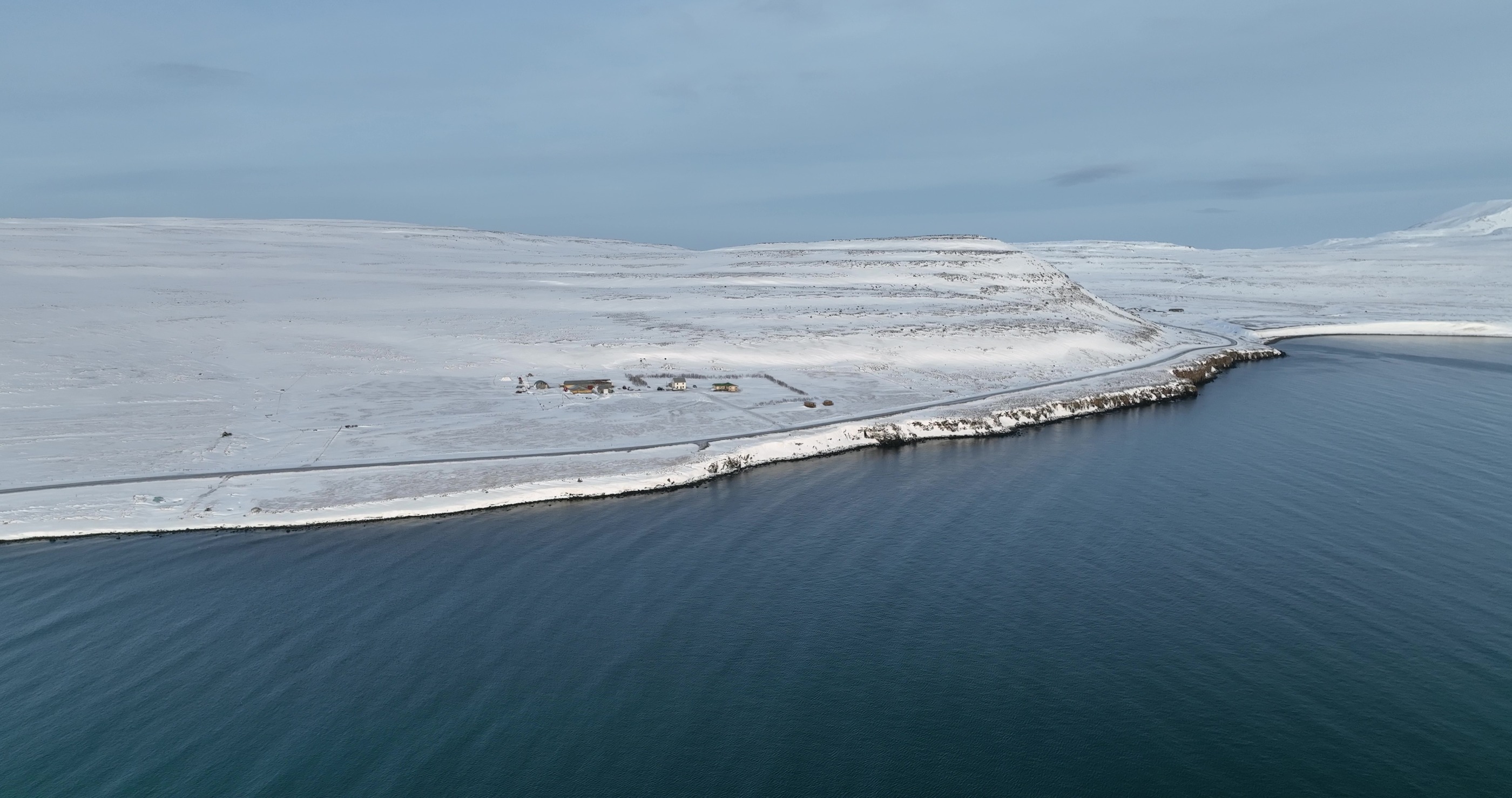
Alyssa and I arrived in Reykjavík (southwest Iceland) on January 16th and the next day started our journey to Finnafjörður on the opposite side of the country (northeast). On the way we became acquainted with slippery, snowy roads. Iceland in winter is stunningly beautiful.
In Finnafjörður, we’re staying with one of the only residents in the area, Reimar Sigurjónsson (who, by the way, has two amazing summer holiday cottages!). In a small farmhouse with Reimar and two gorgeous dogs – Lára and Stígur – we’ve settled into a routine led by the waxing winter days. Sunrise is about 10:30 am and sunset is at 3:30 pm so you need to make the most of any daylight you have! Most days have been too rough to watch whales but we go outside every day, usually for a snowy walk in gale-force winds with the dogs. Either side of that, cosy computer work is the norm.
This is our first winter in Iceland and we’re blown away by the raw, lonely beauty of the place. The rivers of snow that blow past you as make your way through four-foot drifts. The white-on-grey-on-white of the monochrome landscape. The toothy waves gnashing at the frozen shore, with bobbing eiders and soaring fulmars as witness. The imposing mountain of Gunnarfjall as a constant companion in the otherwise-open landscape. I’m currently writing this under the psychedelic watch of polar stratospheric clouds. We feel very fortunate to spend time here.


Whales amongst the waves
This is a very beautiful place but we’re here to focus on the whales. Whenever conditions allow, we hike up the hill behind the farmstead, set up our equipment and look for whales. Trekking up the icy slopes with a large theodolite (instrument to determine whale location) is challenging but feasible, and the views are a helpful distraction.
While we have attempted to scan the seas on numerous occasions, conditions were only optimal on two days (calm seas and good visibility). Amazingly, we’ve recorded sightings on both occasions! I use the term ‘amazingly’ because we really didn’t know what we would see coming here – from a scientific perspective, it’s a truly unexplored place in winter.
On the first day, Tom spotted three blows in the far distance and a few minutes of observations confirmed that they were humpback whales! We are most interested in this species due to their acoustic presence in winter 2021/22, and we’re very curious to see whether the current hydrophone deployment picks up singing at this time. We were ecstatic.
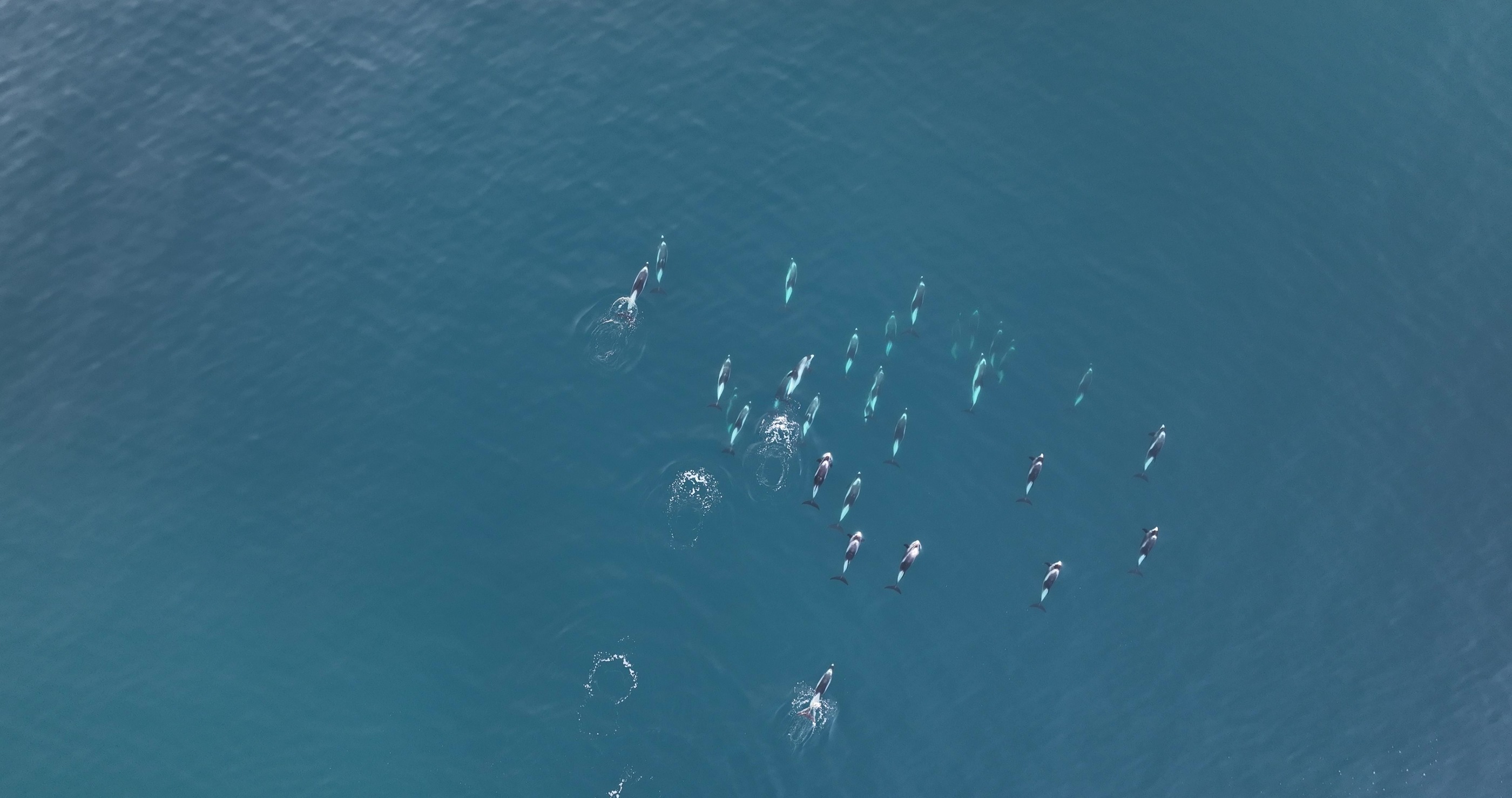
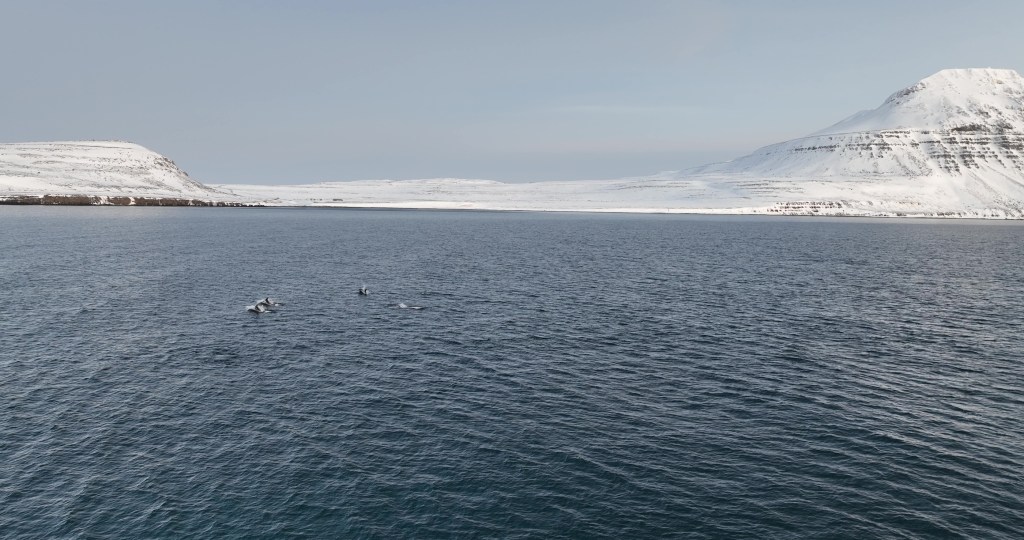
On the second day, we had been watching for a while when Alyssa spotted a pod of white-beaked dolphins charging into the fjord! After we finished our visual survey, we launched the drone to confirm the presence of about 50 adults. Interestingly, no young (small) animals seemed to be present. They spend the next three glorious hours moving back and forth within the fjord, sometimes in bursts of speed, other times milling around on social circles. We don’t know why they were here, but their move into the fjord seemed very deliberate. It’s sobering to think how the port construction would change this habitat.
What’s in store?
As I write this on February 1st, we are planning to spend 1-2 more weeks at Finnafjörður before heading to the Westfjords. Amongst forecast storms, our fingers are crossed for a few more calm days and even more cetacean sightings. After this field season, the next step is to pick up toe hydrophone in July and compare our visual sightings with acoustic evidence of cetacean presence. Stay tuned for results!