 Whale Wise
New publication: How loud are drones underwater?
Written by Amelie Laute, lead author of the publication (cover photo by Amelie).
A few days ago, we published a new paper officially called “Underwater sound of three unoccupied aerial vehicles at varying altitudes and horizontal distances” in the Journal of the Acoustical Society of America (JASA). Sounds fancy? I’ll explain what exactly we did and what we found and tell you the story of how this project came about.
Back story
We have used drones a lot since 2018 to study whales. One day during our field season in 2021, we were out on the water (in Skjálfandi Bay, North Iceland), looking for whales to collect blow samples, but it was really foggy and we had to wait for it to clear up until we could start our research. A discussion started and we wondered whether the sound of the drone that we can hear above the water transmits into the water and how loud it would be for the whales. Since we had to wait for clear weather anyway, we decided to do a quick test. We attached a small hydrophone (HydroMoth) to a buoy and dropped it into the water. We launched the drone and flew it directly above the buoy with the hydrophone; then we flew the drone higher and higher, and further and further away, to see if this would make a difference. When we came back to shore later that day and listened to the recording, we were surprised by how well you can actually hear the drone underwater. We compared the sound depending on how far away we were and realized that the sound seemed to decrease much faster when we moved away horizontally compared to when we flew higher above the hydrophone. We had a look through the published literature and realized three things:
- not many people had analysed drone sound under water;
- the two studies who did only looked at varying altitudes, missing the potentially larger effect of horizontal distance;
- these two studies had not measured our type of drone, and at least from our subjective hearing we expected different drone types to sound very different.
The study
So, during the 2021 field season, we gathered a team, including: the Whale Wise field season crew; Maria Glarou, a PhD student in Húsavík focusing on drone-based research; our acoustic supervisor (and Whale Wise president!) Michelle Fournet; and Marianne Rasmussen from Research Centre Húsavík. Together, we planned a formal experiment to test our hypotheses. In August, we then set out into the bay in the very early morning before any boats were around making background noise. We set out our experimental equipment: a calibrated hydrophone was attached to a buoy, similar to our pre-experiment. Additionally, we attached a rope to this buoy with lots of small buoys along the rope to indicate horizontal distances. The first little buoy was 2 m along the rope indicating a distance of 2 m to the hydrophone, the next one at 5 m, then 10, 20, and 30 m. A drift anchor had to be included to keep the rope straight. As soon as the setup was prepared, we moved away with our little boat and turned off our engine. We launched our drone and flew towards our experimental setup. There, we hovered directly over the hydrophone at 2 m altitude for 20 sec before moving higher to 5, 10, 20, 30, and 40 m, repeating our 20 sec recording. We also flew each of those altitude positions at all of our horizontal distances, ending up with 36 (6×6) positions in total. To be scientifically robust, we repeated each position three times (= replicates). Collaborating with our friend and colleague Maria, we also not only tested our drone (DJI Phantom 4) but also the DJI Mavic Pro and DJI Inspire 1 that she was using – these models are commonly used in marine animal research. Flying three drones three times at 36 positions, we really had a lot to do. It took many mornings and many hours on the water, with many, many drone batteries until we had all the data. Dealing with changing and unforecasted weather was a particular challenge! When we finally completed the last flight, we were excited to get to the computer and analyse the recordings.


Connecting the hydrophone to the rope and the final set up! The buoy with the hydrophone is on the right end of the rope and the draft anchor is on the left end. Photos by Alyssa Stoller and Maria Glarou
The results
I will not give full details of data analysis in this blog. We used a combination of software tools like RavenPro, PAMguide, Audacity, and R, but for those interested in the details I’d encourage you to read the official paper HERE . Instead of talking too much about methods, I really want to tell you what we found!
So, indeed, we could hear all of our drones well underwater, some of them even at 40 m altitude. Our hypothesis was confirmed, that the different types of drones sounded differently. While the Mavic was the quietest, only audible to the human ear when the drone was close to the hydrophone, the Phantom was much louder and the Inspire was the loudest. All drones made their sound mostly in the low frequencies (~ 150 Hz to ~ 15kHz), a range potentially audible to the baleen whales we fly above. Additionally, the Inspire had a peak of energy (sound) between 30 and 35 kHz, much too high for humans and probably also for baleen whales to hear but possibly audible to dolphins and porpoises. So if you want to fly above an animal with a drone, choose your drone model wisely and check out our paper for advice beforehand 😉.
Currently, when people use drones for research, they try to maximize their height above the targeted animal to reduce potential impacts. With our data, we could confirm that flying higher decreases the amount of sound received under water. However, we found that the sound was reduced much more quickly when we flew away horizontally, rather than vertically. In other words, you have to fly many meters high to get the same noise reduction as flying away horizontally only a few meters. This has to do with how sound waves propagate and how they get transmitted into the water. Knowing this is really useful for researchers: especially if you want to use drones for behavioural observation, you don’t need to be right above the animal. You can just stay a few meters behind and drastically reduce the impact you have on your targeted individuals. This is important for the sake of the animal, but also to reduce the potential behavioural changes due to the presence of the drone. If your study requires you to fly right above the animal, e.g. aerial images (like we do), you can try to reduce the amount of time spent directly above, and instead for example wait for the animal to surface staying some meters behind. Obviously, if it works for your project, staying away horizontally and maximizing altitude is even better.
Whether the animal is able to perceive the sound of the drone doesn’t only the drone type and position (so how much energy is transmitted into the water). It also strongly depends on the animal’s ability to hear those frequencies at those intensities. As we humans are not able to hear the ultrasound a bat is making when echolocating, each species (and also each individual) has specific hearing capabilities. While for dolphins and porpoises, seals, and some fish we have quite a good understanding of what they hear, we are much more uncertain about large whales, like humpback whales. They are simply too big to put in a tank and measure their hearing. So it’s better to just be as quiet as possible when doing research to make sure we don’t disturb the animals we are interested in.
If you want to use a drone for research (or other purposes) yourself or if you want to learn more about our experiment, check out our new publication; you can download it HERE.
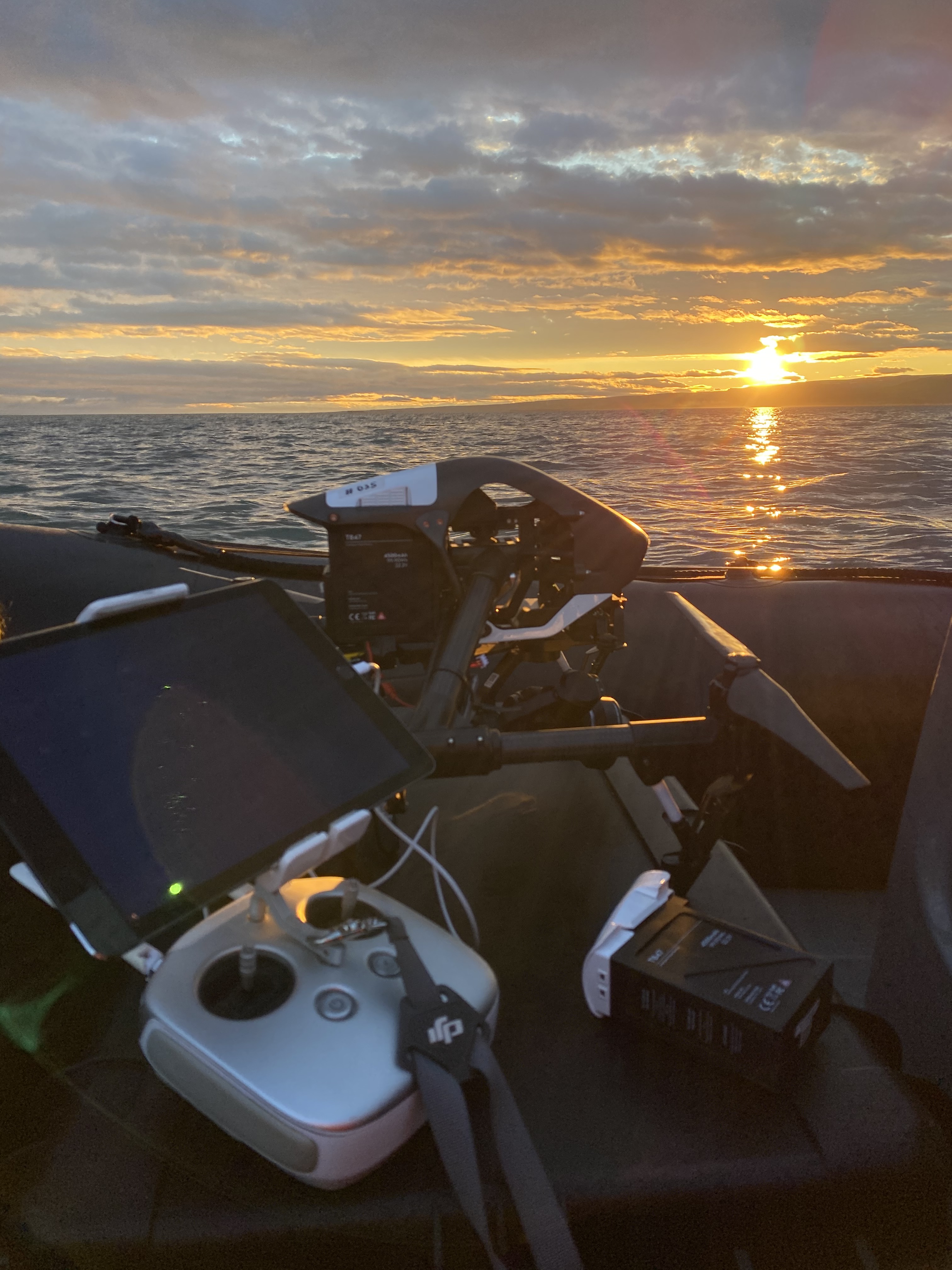
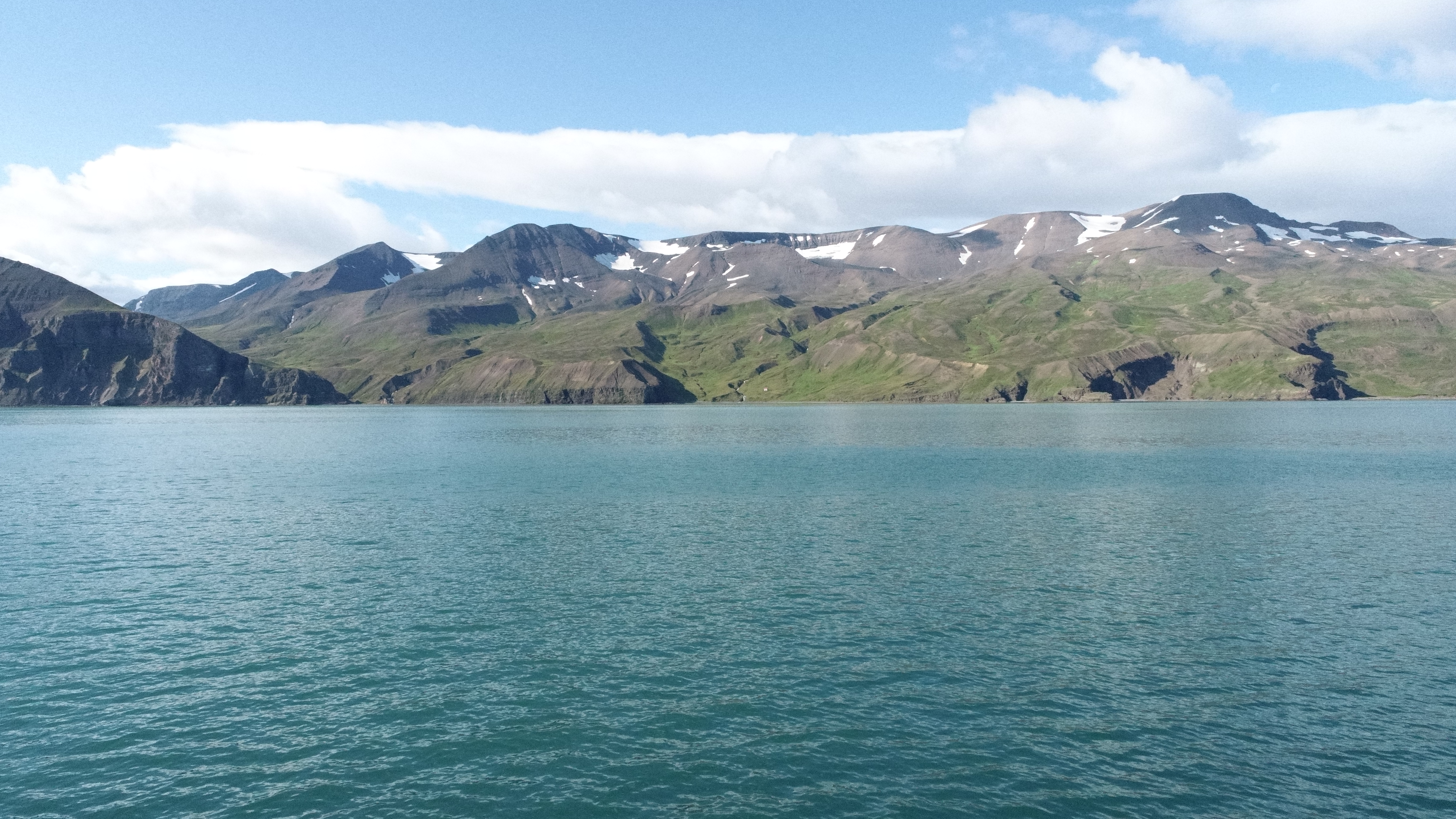
The Inspire drone ready for action and a beautiful morning in Skjálfandi Bay.
Full reference: Laute A, Glarou M, Dodds F, Røsand SCG, Grove TJ, Stoller A, Rasmussen MH and Fournet MEH (2023). Underwater sound of three unoccupied aerial vehicles at varying altitudes and horizontal distances. JASA (Journal of the Acoustical Society of America), 153:3419. https://doi.org/10.1121/10.0019805. Download here
Thanks for sharing the story behind this great paper, and congratulations on the publication. This is super interesting and relevant. I have been wondering about the same for my master thesis – how noise from drones and aircraft propagates into the water column. And next, how do drones in behavioural research on noise interfere with the very same behavioural observations… Really happy about the work you have done! I only found a handful of studies about helicopters and small aeroplanes that concluded that it is not propagating very far – and is indeed very directional.
Hi Fabienne, thank you for reading the blog! Glad this research can be of help and that we can add to the body of evidence for underwater drone noise.