 Whale Wise
On the magic of wild whales and wilder oceans
by Jessica Antonisse: “A field note from one of my favourite days as an assistant whale researcher“.
I love the ocean in all her states and forms, lovely and wild. I can call up the turquoise waves of the Indian Ocean clearly in my mind, but love the grey waves of the North Sea just as much. The calm after a storm, but also sailing on rough seas has weirdly proven to be one of my favourite things. I have my reasons. The story I am about to tell you might be one of my favourite field notes during my two months as an assistant whale researcher.
I set out to help collect data on humpback whale presence in Ísafjarðardjúp (meaning deep icy fjord) as a volunteer with the NGO Whale Wise. Humpback whales return to Iceland each year to feed in the coastal waters. They can appear year round in the fjord, but on average most start to appear around May, increasing in numbers until they leave likely in December. Humpback whales are amazing animals. Not only because of their impressive size, but also because they make one of the longest migrations in the ocean. These humpback whales spend the summers around Iceland but are spotted along the West African coast as well as in the Caribbean in winter.
How do we know it’s the same whale we spotted in the Westfjords and in Cape Verde? That’s where this research comes in. Whales have unique patterns on the underside of their tail, their fluke. These black and white patterns make it possible for us to identify them. The method we use is photo identification — we simply take a picture of the underside of the fluke and compare these pictures. The whales gracefully provide us with this view each time they go for a dive. They need the propulsion to get themselves down into the water. So, that is how I ended up on multiple boat trips each day with a huge camera and a huge smile every time we encountered the giants.
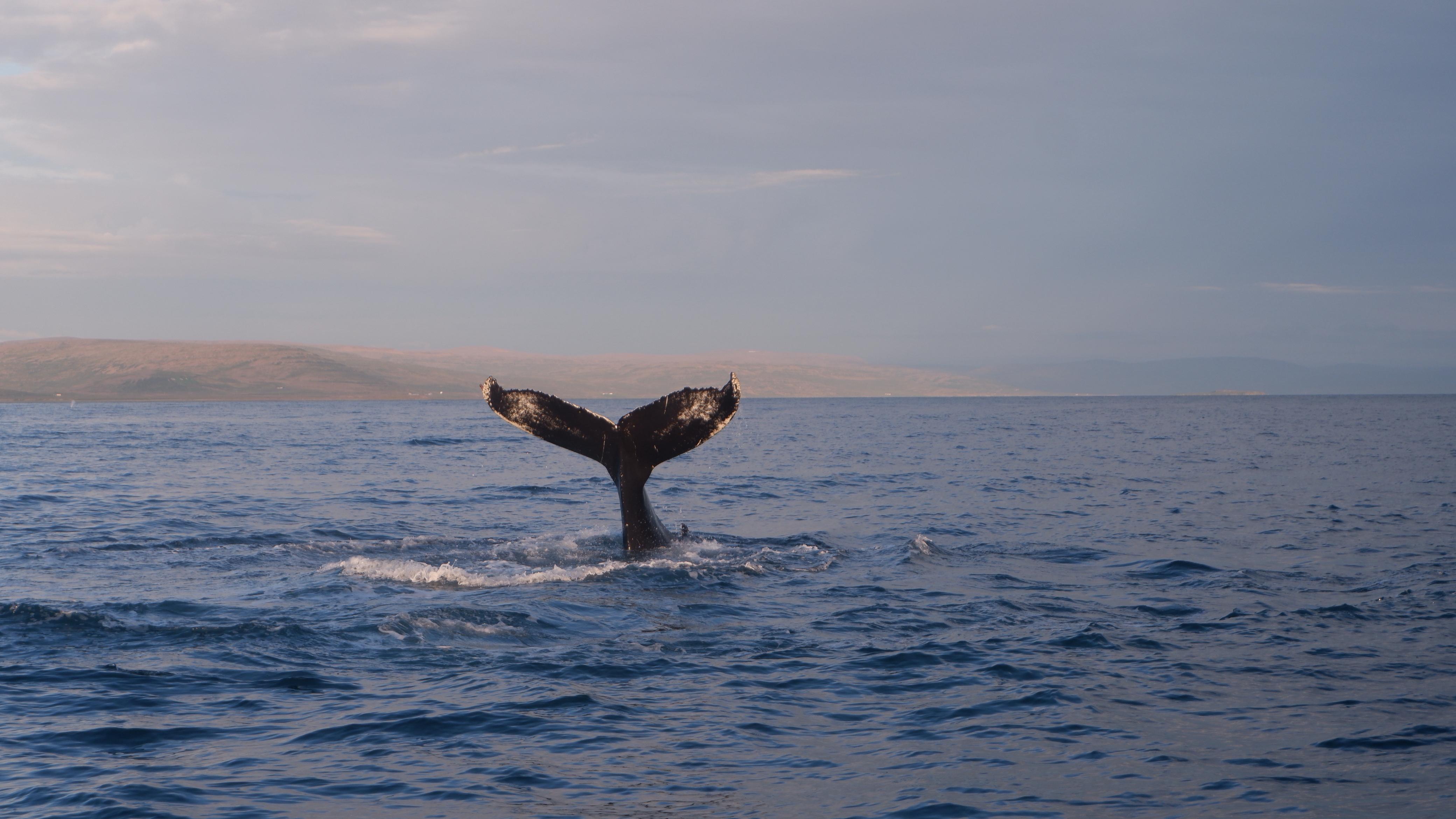
Most days, the water was quite calm as we filled up the boat with short-term visitors to Ísafjörður who joined the trip to see the whales. We would leave the town behind quickly, setting out into the fjord system, and often return to the point where we’d seen our friends last. For a while, three individuals stuck around in the fjord next to us. The mountains surrounding it provided even more shelter, and we got to spend quality time with Vibis, Orb and Ibis before returning to shore. It is not uncommon for whales to stick around a favourite spot for a while — probably it just meant there was plenty of food. That is what they are here for, after all, to eat, all summer. A lot of the individuals are seen returning each year, suggesting they have some place attachment: they like it here. After a few weeks though, the whales slowly moved on. First, we found only Orb and Ibis in the fjord, and soon it was empty again.
On this particular day though, the ocean was not calm, but quite rough. We took out one of the smaller vessels and had about fifteen good-spirited guests with us. This was around the time we still encountered the two friends one fjord over, and that is where we headed. As quick as possible over the big waves, we sailed out of the bay and into the next, back in the shelter of the mountains. As usual, the trip was guided by Tom and Alyssa, founders of Whale Wise and brilliant whale researchers. Next to being great humans they are excellent whale spotters — they can spot a blow or a dorsal fin from impossible distances, often already able to identify the individual whales by the time I finally lay my eyes on them. Today though, their usual calls of “blow!”, “at two o’clock!” or “fluking!” were not coming. Was this going to be my first trip without any whales? I was starting to feel bad for my fifteen fellow travellers, who had taken a chance in this bad weather to come aboard and hopefully spot these creatures.
We set out back into open ocean. On a regular trip people often stand outside, but now everyone was seated inside as the captain expertly navigated us through the big waves. This was definitely the wildest sea I’d been sailing on. It had also started to rain. But the captain had heard from another boat that a whale had been spotted further out, so we took our chances. As we got thrown around by the ocean, we also got closer, and finally, there was Tom calling out — loudly — a call I had not yet heard: “breach!!”. Further ahead of us, a whale was throwing itself out of the water and coming back down with a huge splash. We were still far off, and there is no telling whether the whale will breach only one time or repeat it. Soon, we were crowding the captain trying to get a good look through the front window. The whale kept on breaching, Tom pointing in its direction and telling the guests to watch for the “sausage in the distance” that came up every now and then, while we slowly got closer.
We got as close as we dared without disturbing the whale. This was the moment I looked at the captain with no small amount of hope and asked: can we go outside? The answer was “sure” and if there was more, I did not listen. Getting to the front deck was a challenge in itself. The boat was being thrown around in the rain, the waves splashing on deck. But I found my way to the seats in front, sat down, held on, and watched the most incredible show. I think the whale breached forty, maybe fifty times. It just kept coming back up, arching through the sky and crashing back down. I was now close enough to hear the huge sound of the splash. Underwater, this sound travels kilometres far. Sitting on the front deck, getting soaked by the waves with one arm wrapped around the railing to stay in place, I felt a connection to nature in a way that made me emotional. It’s so cool to see the entire animal, whereas you often only get to see the dorsal fin or fluke. But more than that — the behaviour made me think about the inner motivations of the whale. There is often a warning against humanizing animals — anthropomorphizing them — as if only humans have inner lives. But the scene felt full of quiet joy, despite the loud display. As if the whale also enjoyed being out there in the storm, perhaps communicating with the giant crashes, playing around, showing off.

Since that trip, each time the ocean showed signs of swell or less than ideal weather, I got my hopes up. But the truth is, every encounter before and after had filled me with awe too. There were calm days with lazy whales, coming up for air and showing their fluke. There were misty days surrounded by so many I was not even sure where to look. There were days with multiple trips from shore to the whales and back, and none of it ever got boring. I could tell you loads more about the whales and all I learned in my short time volunteering with Whale Wise, and I probably will at some point. But for now, I will leave you out on the front deck in the rain, holding on for dear life and wishing the boat did not need to return to shore at all.
Be sure to read more from Jess: